We traced the line from the original outlaws to the modern artists carrying that same “do it my way” spirit.
Nashville has always had rules. Dress a certain way. Sound a certain way. Let the label pick your songs, your producers, your album cover, your haircut. For most of the music industry’s history, artists who wanted a shot at the big time played by those rules, or they didn’t play at all.
Then came the outlaws. And nothing was ever quite the same.
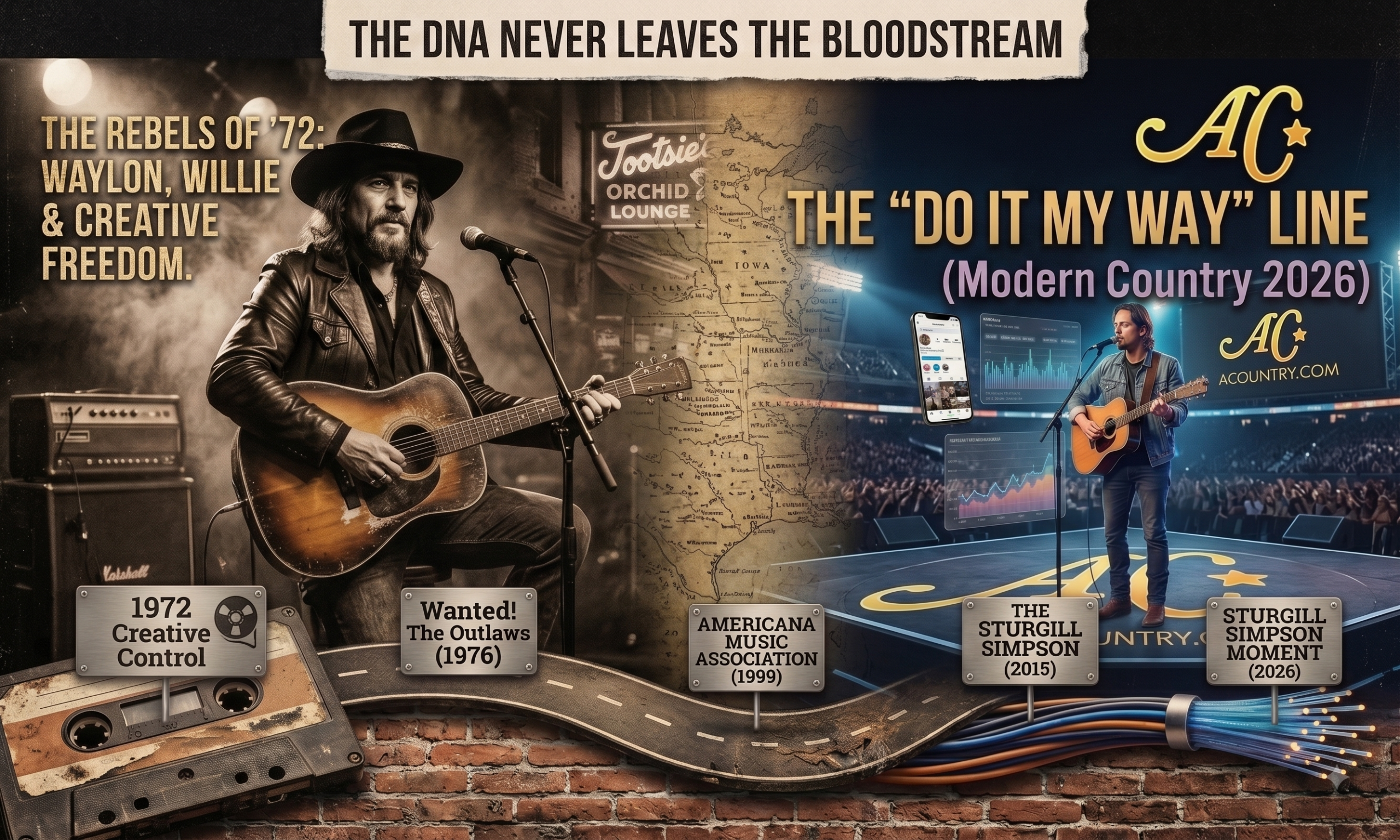
The Outlaw Country movement didn’t just produce great music. It permanently rewired what was possible in Nashville and set a template for independent-minded artists that echoes all the way into 2026. The spirit never died. It just changed addresses a few times.
Here’s the full timeline from the smoky rooms of 1970s Nashville to the independent streaming era artists who are living proof that the outlaw DNA never leaves the bloodstream.
1972 — The Breaking Point
By the early 1970s, Nashville’s recording industry had become a polished, highly controlled machine. The “Nashville Sound” was lush orchestration, background vocal choruses, smooth production and it had been enormously commercially successful through the 1960s, but it had also smoothed out the rough edges that made country music feel honest in the first place.
Waylon Jennings had been fighting the system for years. He hated being told which songs to record. He hated the session musicians the label assigned to his records. He hated that he had no control over the final product bearing his name.
In 1972, he renegotiated his contract with RCA Records and won something almost unheard of at the time: full creative control. His own band in the studio. His own production decisions. The label would distribute the record. Everything else was his.
It was a small clause in a contract. It changed country music forever.
1973–1975 — Waylon and Willie Build the Fortress
While Waylon was fighting his battles in the studio, Willie Nelson had already done something more radical: he’d left Nashville entirely.
After years of being told his sound was too different, too jazzy, too unconventional for mainstream country radio, Willie relocated to Austin, Texas in 1971 and essentially started over. He let his hair grow. He started playing rock venues alongside country bars. He built an audience that didn’t fit the Nashville demographic mold, and he did it completely on his own terms.
The Austin scene that Willie helped create, and that artists like Jerry Jeff Walker, Guy Clark, and Townes Van Zandt populated, became a parallel universe to Nashville. Same genre, completely different atmosphere. No suits in the room. No label A&R executives approving set lists. Just artists playing what they wanted to play for crowds who came specifically to hear something real.
Nashville took notice. It couldn’t ignore the sales numbers.
1976 — The Album That Named a Movement
Wanted! The Outlaws was released in January 1976 and became the first country album in history to be certified platinum. It featured Waylon, Willie, Jessi Colter, and Tompall Glaser. Artists who had all, in different ways, pushed back against the Nashville establishment.
The album was initially conceived as a budget compilation by RCA, repurposing existing recordings. It was not supposed to be a statement. It became one anyway.
The title named a movement that had already been happening organically for years. Suddenly there was a word for it. Journalists had a frame. Fans had a tribe. And the Nashville establishment had to reckon with the fact that the artists they’d tried to control had just outsold everyone who’d played by the rules.
Key artists of the era: Waylon Jennings, Willie Nelson, Kris Kristofferson, Billy Joe Shaver, David Allan Coe, Tompall Glaser, Jessi Colter, Guy Clark, Townes Van Zandt.
Late 1970s–1980s — The Movement Gets Absorbed
Here’s the uncomfortable truth about every musical rebellion: when it starts selling enough records, the machine finds a way to absorb it.
By the late 1970s, “outlaw country” had become a marketing category. Labels began signing artists specifically because they had a rebellious image, packaging that image as a product. Some of those artists were authentic. Some were wearing the hat without understanding what it meant.
Waylon himself grew frustrated watching the commercialization of something that had started as a genuine fight for creative freedom. The authenticity that had made the movement powerful became, for a period, a costume.
But the roots didn’t disappear. They went underground and waited.
1986–1990 — The Next Wave: New Traditionalists
While the outlaw spirit was being diluted on mainstream radio, a new wave of artists were quietly staging their own rebellion, this time against the pop-country excess of the early 1980s.
Dwight Yoakam drove from Kentucky to Los Angeles and found his audience in the punk and alternative clubs on the Sunset Strip, playing for crowds who had no idea what country music was supposed to sound like and therefore had no problem with what he was doing. His debut album Guitars, Cadillacs, Etc., Etc. came out in 1986 and sounded like Bakersfield by way of a freight train.
Steve Earle released Guitar Town the same year and immediately got into fights with his label about the direction of his career. He would spend the next decade making increasingly uncommercial records that became increasingly influential.
Randy Travis arrived as a direct counter to the synthesizer-heavy pop-country of the era and reminded Nashville what a traditional country voice could do to a room.
They weren’t outlaws in the Waylon mold. But they were all, in their own way, saying no to something.
1990s — The Underground Keeps Burning
While Garth Brooks was selling out stadiums and Shania Twain was crossing country over into pop territory, the outlaw tradition was being kept alive in smaller rooms and on independent labels.
The Americana movement was formalizing. The Americana Music Association was founded in 1999, creating infrastructure for artists who didn’t fit neatly into the Nashville radio system. Artists like Lucinda Williams, Jimmie Dale Gilmore, and Joe Ely were building careers entirely outside the mainstream pipeline and finding audiences who preferred it that way.
Texas and Red Dirt country were developing their own full ecosystems. Pat Green, Cross Canadian Ragweed, and the Turnpike Troubadours were selling out Texas dance halls without a single significant radio hit. The model was different: regional loyalty, relentless touring, direct connection to fans, but the spirit was recognizable. Do it yourself. Answer to nobody.
2000s–2010s — Hank III Picks Up the Flag
If one artist in the 2000s most directly inherited the confrontational energy of the original outlaw movement, it was Hank Williams III. Hank Jr.’s son, Hank Sr.’s grandson, and a man who seemed constitutionally incapable of making music that would please a radio programmer.
Hank III spent years in a legal battle with Curb Records, a label he openly and repeatedly referred to in the press as his enemy. He released albums of aggressive country-punk. He played three-hour shows that began with traditional country and ended with something closer to metal. He made Nashville uncomfortable in exactly the way his grandfather’s music had made Nashville uncomfortable half a century earlier.
Meanwhile, Jason Isbell was getting sober and making Southeastern, one of the most critically acclaimed country-adjacent albums of the decade, on an independent label with no radio support and a fanbase built almost entirely on word of mouth and live performance.
The pattern was consistent: the artists doing the most interesting work were the ones operating furthest from the center.
2015–2020 — The Sturgill Simpson Moment
Sturgill Simpson released Metamodern Sounds in Country Music in 2014 and the conversation about what outlaw country meant for a new generation got a lot louder in a hurry.
Here was an artist who sounded unmistakably like classic country: the voice, the phrasing, the steel guitar. But his lyrical content and philosophical framework were completely his own. He wasn’t playing by the Nashville radio game. He wasn’t chasing a hit single. He was making exactly the album he wanted to make and letting the audience find him.
They found him. A Sailor’s Guide to Earth won the Grammy for Best Country Album in 2017. He didn’t attend the ceremony.
That moment was important. It proved that the audience for uncompromising, artist-driven country music was larger than Nashville had been assuming. It gave permission (or at least evidence) to a new generation of artists that you didn’t have to play the mainstream game to build a real career.
2020–Present — The New Outlaws
The streaming era has done something interesting to the outlaw tradition: it has removed the bottleneck.
In the original era, getting around Nashville meant fighting for a recording contract on better terms or self-releasing physical records with limited distribution. The barriers were enormous. The fight was real.
Today, an artist can record an album, release it independently on every platform simultaneously, build a following on social media without a label’s marketing budget, and sell out tours by connecting directly with fans, all without asking anyone’s permission.
That doesn’t make it easy. The landscape is more crowded than ever. But the core outlaw proposition: do it your way, answer to yourself, build something real, is more achievable now than at any point since Waylon renegotiated that RCA contract in 1972.
The artists carrying the flag right now:
Zach Bryan built one of country music’s most devoted fan bases almost entirely through raw, unproduced videos posted online before he ever had a label deal. His sound is unpolished by design. His connection to his audience is direct and unmediated. The major label deal eventually came, but the audience came first, and that reversal of the traditional order is everything.
Tyler Childers operates out of Eastern Kentucky and makes music that is deeply, specifically regional in a way that mainstream Nashville has no framework for. His albums deal with Appalachian life, faith, struggle, and place with a specificity that resists easy formatting into a radio single. He sells out large venues anyway.
Cody Jinks spent years building a fanbase through relentless independent touring before major label interest arrived, and he’s consistently made decisions that prioritized creative control over commercial convenience. His audience followed him through every one of those decisions.
Nikki Lane has been called the Queen of Outlaw Country, a title she wears the way the original outlaws wore theirs, which is to say, lightly and with a lot of style. Her records are produced with a vintage aesthetic that nods directly to the 1970s source material while remaining entirely her own.
Charley Crockett releases music at a pace that suggests someone who doesn’t believe in waiting for permission and tours with a relentlessness that would have felt familiar to the original outlaw circuit of Texas dance halls.
The Through Line
Every generation produces its version of this story. An artist or group of artists who decide the rules don’t apply to them, who find an audience that agrees, and who, in doing so, expands what’s possible for everyone who comes after.
The specific fight changes. In the 1970s it was about studio control and creative ownership. In the 1990s it was about surviving outside the radio system. Today it’s about building a direct relationship with an audience in an environment where the gatekeepers have lost most of their power.
But the core of it, the “do it my way” defiance that Waylon sang about, that Willie built his whole second career on, that Kris Kristofferson was scribbling on napkins in the back of Tootsie’s, that part hasn’t changed at all.
Outlaw country isn’t a genre. It’s a disposition. And it’s not going anywhere.
Explore more deep dives into country music history and the artists shaping its future at acountry.com.

Leave a Reply