There’s a shift happening in country music right now, and you can hear it regardless of whether you’re tuning in from a backroad in Tennessee or a subway in London. The genre is experiencing a massive global explosion. Driven by an unstoppable digital wave, country music has secured roughly 8% of all on-demand audio streams in the US alone, with global growth accelerating across Europe, Latin America, and Asia.
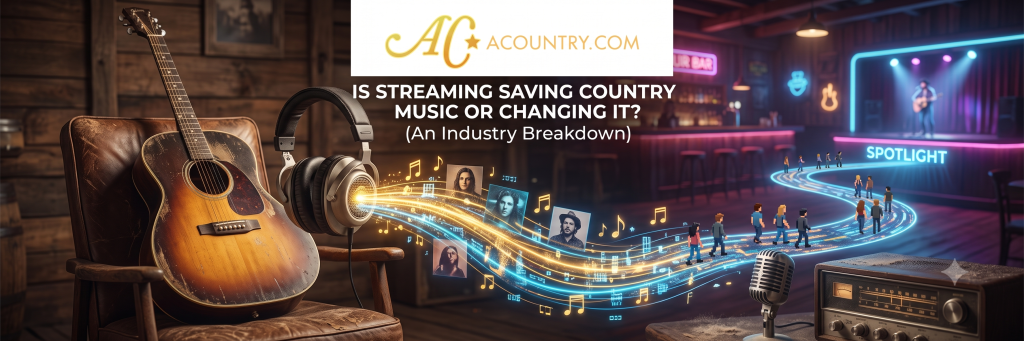
But this digital boom brings up a massive question for the culture: Is streaming completely changing the authentic sound of country music, or is it actually saving it?
Depending on who you ask, algorithmic playlists are either the best thing to ever happen to the genr, or a corporate machine dilution of its roots. Let’s break down both sides of the coin.
The “Saving It” Argument: The Demise of the Radio Gatekeeper
For decades, getting a country song heard meant going through a very specific, traditional pipeline: Nashville terrestrial radio. If a track didn’t fit the hyper-specific, polished sound that radio programmers wanted, it rarely saw the light of day.
Streaming changed the rules of engagement entirely.
- The Rise of the Indie Outlaw: Artists like Zach Bryan, Tyler Childers, and Sierra Ferrell didn’t climb the traditional charts to get noticed. They built massive, cult-like followings on platforms like Spotify, Apple Music, and TikTok first.
- Global Democratic Discovery: Algorithms don’t care about corporate radio politics. If a song resonates with listeners, the platform serves it up to thousands more via personalized discovery loops.
- The Return of Raw Storytelling: Because indie and alternative country artists no longer rely on commercial radio play to survive, they are free to make music that sounds rugged, honest, and unpolished. In a strange twist of irony, the most digital medium available has actually allowed the most traditional, acoustic, and authentic sub-genres of country to thrive on a global scale.
The “Changing It” Argument: Pop Crossovers and Eight-Second Hooks
On the flip side, many traditionalists argue that streaming is flattening the genre’s edges. When your economic survival relies on a user not hitting the “skip” button on a curated playlist, the way you write songs changes.
- Front-Loaded Tracks: Traditional country is famous for slow burns. Think of a long, mournful pedal steel intro. Today, streaming optimization means many tracks are written to deliver a catchy hook within the first eight seconds to capture short attention spans.
- The Algorithmic “Pop-Country” Blend: To maximize global reach, major label country music has increasingly leaned into trap beats, synth production, and pop structures. Because algorithms favor high-volume consumption, the genre often gets cross-pollinated with mainstream pop and hip-hop to appeal to the widest possible demographic.
- The Loss of Regional Identity: When music is engineered to play just as well in a Tokyo coffee shop as it does in a Texas honky-tonk, some critics argue that the distinct, localized dirt and grit that defined the “authentic” country sound gets washed away.
The Industry Breakdown: By the Numbers
- Gen Z & Millennials now make up roughly 40% of the active country music listening demographic, completely shifting the target audience away from older, radio-dependent formats.
- On-Demand Audio is growing at double-digit rates globally, with mid-sized international music markets seeing the fastest percentage growth in country consumption.
- Indie Power: Independent and self-released artists represent one of the fastest-growing sectors on streaming platforms, proving that major label backing is no longer a prerequisite for a stadium-level tour.
The Verdict
Ultimately, streaming is a double-edged sword. It has undoubtedly diluted parts of the mainstream scene into a hyper-polished, globalized pop-hybrid. But it has also given a microphone to the outlaws, the traditionalists, and the independent storytellers who would have been completely shut out of the old system.
It hasn’t killed the authentic sound of country music; it just forced it to find a new home in the digital underground.
Over to You!
We want to know what the scene looks like through your headphones. How do you discover your music these days? Are you diving deep into algorithmic radio, tracking down independent playlists, or do you still trust your local dial?
Drop your thoughts in the comments below and let’s talk!

Leave a Reply